
Why mental regeneration is important
According to the 2022 job stress index published by Health Promotion Switzerland, just under a third of employed people are emotionally exhausted. Many people need a break, even if they don't have time for it. After a period of stress, in which the body produces more dopamine, cortisol and adrenaline, a period of relaxation is absolutely essential. Even if it's only short, taking a daily break for our physical and mental health is very important. In a study by the University of Konstanz, psychologists observed that after just ten minutes of massage, participants experienced a relaxation effect, both mentally and physically. By using short relaxation techniques you can effectively reduce stress at the psychological and physiological levels. The body eliminates stress hormones, your muscles can relax again and your blood pressure falls. Imbalance can be unhealthy over a longer period of time and lead to negative consequences such as burnout. We also become less productive and more vulnerable to health problems. Regular breaks are incredibly important for mental regeneration as well as for the body.
Discover five ideas for taking a break at home
Over time stress becomes unhealthy. To combat this, even taking little breaks throughout the day can work wonders. Five fans of relaxation reveal their very personal methods for switching off at home from the daily routine.1. Tidy up to clear your mind
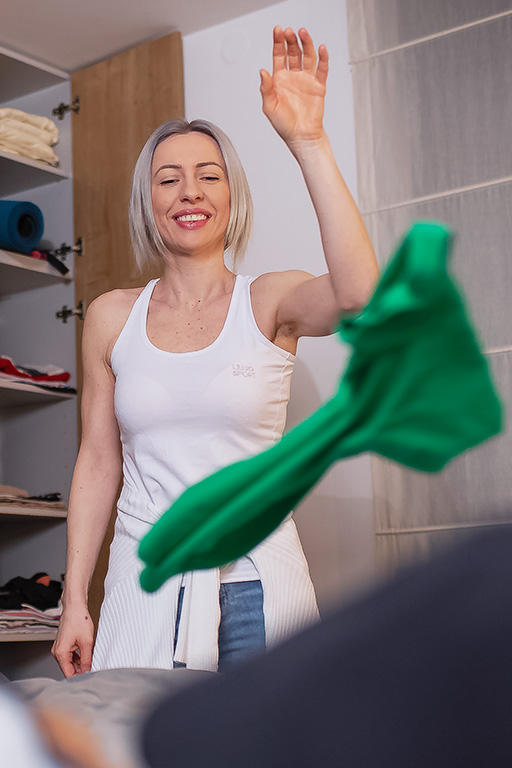
"Tidying up relaxes me and afterwards I even feel a bit tidier myself." Dana, age 42.
What may seem like work to some – tidying up – is relaxing for Dana. Many studies have confirmed the link between your living environment and your psyche. A disorderly and cluttered abode can have a negative effect on your mood. Dana explains that most of the objects in our homes are ones that we choose ourselves and therefore conscious(ly) express a part of ourselves. If our home is chaotic or too full of things, that can be reflected in our feelings or actions. Thinking freely is difficult because our home doesn't provide any space for it. This is something that Dana often noticed herself. There's no room for relaxation. That's why Dana goes through all of her belongings at regular intervals and gets rid of things she doesn't need. She throws unnecessary ballast away, which creates room for new things. Getting organised not only tidies up your home but also clears and relaxes your head.
Dana's tip: Set fixed dates for decluttering in your diary and only keep what really suits you. You can get rid of any items that you haven't used in the last six months.
2. Count to calm your mind

"When I count, I can slow down immediately – it's like a meditation for me." Sandra, age 33.
Whether she's counting the mosaic tiles in the toilets of a restaurant, stripes on a jumper or the street lamps on the way to work, counting is a sure-fire way for Sandra to slow down. While we're counting, we concentrate our minds on the activity and block out everything around us. So if you're stressed and need to calm down quickly, counting the floorboards in the living room or petals on the flowers in a vase may help.
Sandra's tip: "Before I come home from work, I stop and stand in front of the door and focus on my breathing. I breathe in through my nose and count to five while I'm doing it. Then I breathe out through my mouth while counting to five. Within just a few seconds I feel relaxed and a bit clearer in my head."
3. Working with your hands to switch off

Working with your hands has been proven to strengthen your resilience and lower your cortisol levels. Various studies have proven that creative hobbies such as crafting, ceramics, painting or knitting have a positive impact on people's mental health. Anna discovered the positive side effect of ceramics for herself a few years ago: "When I'm doing ceramics, I forget everything around me. I'm submerged in a completely different world and I'm very relaxed." While you're working in a focused manner and concentrating only on creating your work, there's no space for other thoughts. According to a study done in New Zealand, people with a creative hobby have positive attitudes and they thrive.
Anna's tip: Sometime during this autumn and winter, pick up some knitting needles or a paintbrush instead of a TV remote.4. More wellbeing with autogenic training
"Whether at the workplace, out and about or at home, simple autogenic training exercises make me feel calm and boost my concentration." Lukas, age 37.
For Lukas, autogenic training is the most effective method for quickly getting himself into a deep state of relaxation and letting go of hectic day-to-day concerns. By using thoughts and imagery we influence the functions of our nervous system and in turn our muscles, heart, blood vessels, breathing, and senses. Mastering autogenic training successfully requires constant practice. It's advisable to take a group course first and then later to do autogenic training independently. If you practise regularly then all you'll need is a few minutes to relax your entire body and let go of your daily concerns.
Lukas's tip: After just a few simple exercises you can feel relaxed. Get into a position that's pleasant for you, either lying or sitting. Repeat the following sentence at least six times to yourself in your head with clear words: "My pulse is pleasantly calm, strong and steady." This little exercise will quickly make you feel calm.
5. Deep relaxation with rustling noises
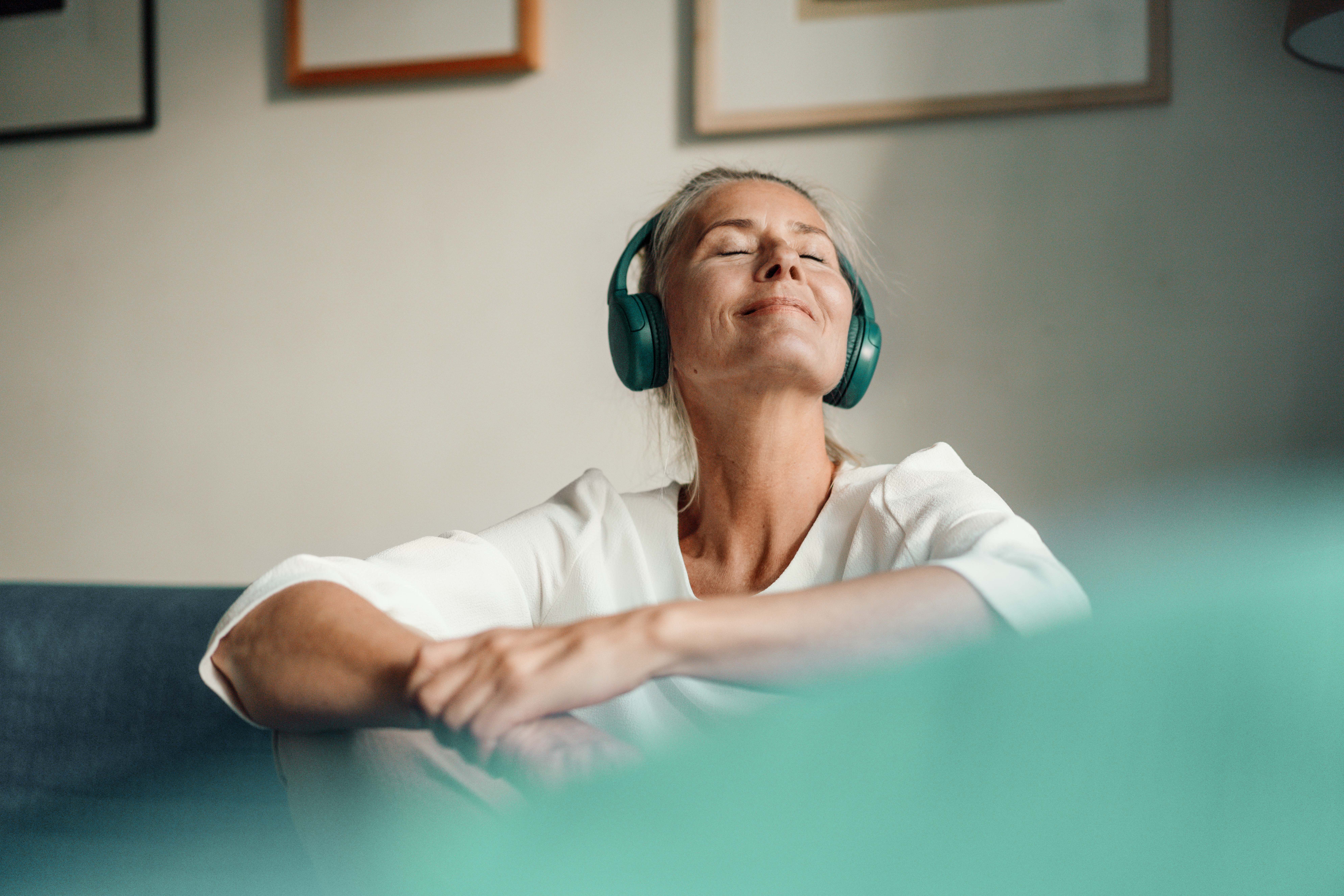
Bettina is wearing large headphones and sitting on the sofa. She's listening to a song with rustling noises: "When I hear something like this, I get a pleasant feeling of goosebumps. It relaxes me." Bettina, age 49. These kinds of noises are called ASMR sounds. The rustling of a crisp packet or leaves, whispering or breathing – on the internet you'll find many videos with these sorts of ASMR sounds. ASMR stands for Autonomous Sensory Meridian Response, the independent reaction of your body to sensory stimuli. These stimuli can be auditory or visual. They prompt a tingling sensation in your body. People describe this body response as similar to goosebumps or a prickling feeling that goes from the scalp to the spine and then the shoulders. ASMR helps with relaxation, falling asleep and coping better with stress. In short, ASMR relaxes you and slows down your pulse. The most popular sounds include water, whispering, knocking, the sounds of playing and the operation of a controller, smacking noises or the sound of hands rubbing together.
Bettina's tip: create your own ASMR sounds or video playlist. Then you'll always quickly have a few sounds at the ready at home or on the go to help you relax. So put your headphones on and get to relaxing.
Would you like to learn more about the ASMR phenomenon? Here you can check out a report from SRF.


